
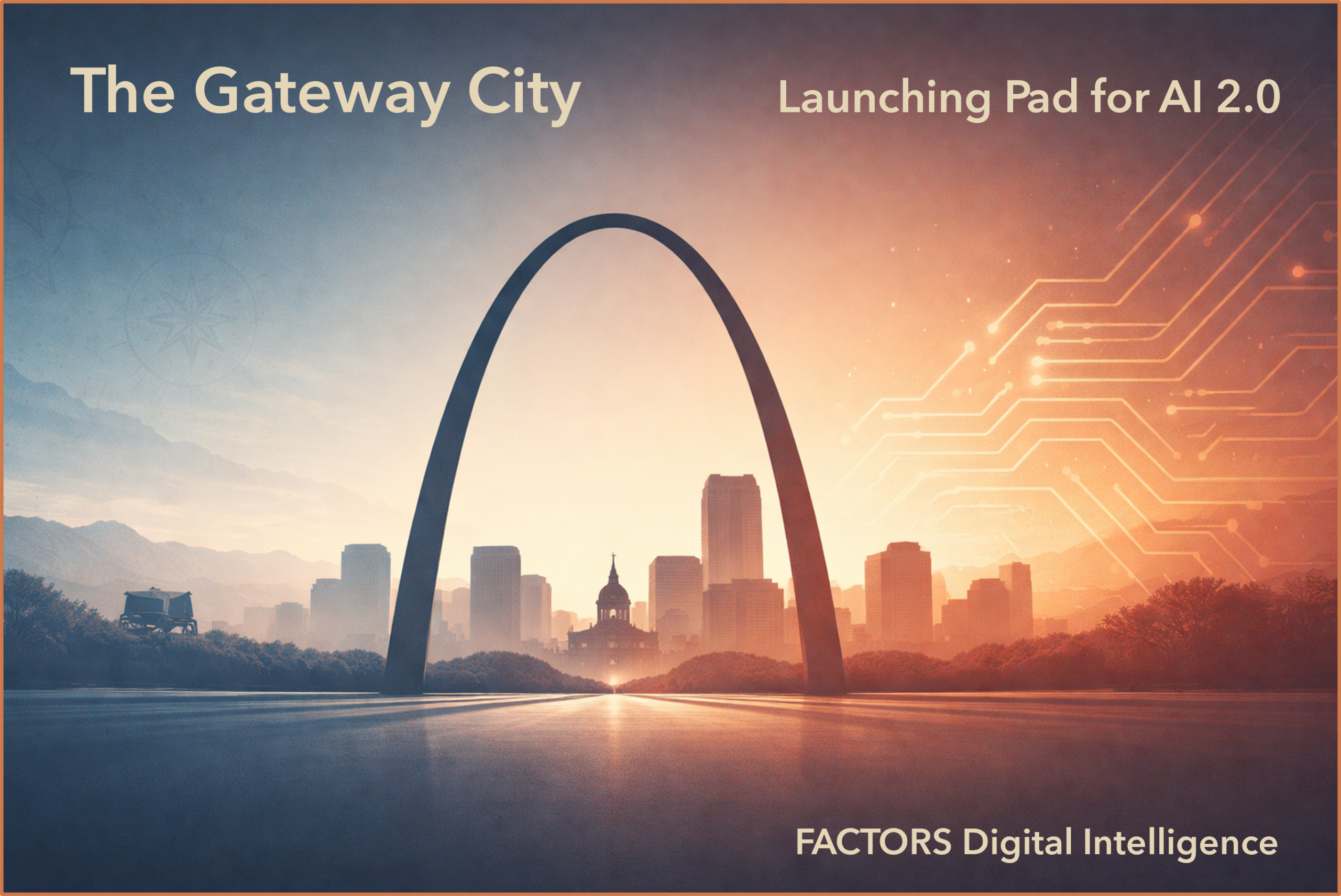
Why St. Louis Can and Should Be the Epicenter for the Next Era of AI
For nearly two centuries, St. Louis has been known as the Gateway City.
In the 19th century, explorers, settlers, and entrepreneurs gathered along the Mississippi and Missouri Rivers before venturing westward to explore a vast and uncertain frontier.
From this city, journeys began that reshaped the nation.
In the 19th century, explorers, settlers, and entrepreneurs gathered along the Mississippi and Missouri Rivers before venturing westward to explore a vast and uncertain frontier. From this city, journeys began that reshaped the nation.
Today humanity stands at the edge of another frontier. Not a geographic frontier, but an Intelligence Frontier.
Artificial Intelligence is rapidly transforming how we work, learn, govern, discover knowledge, and understand the world. The first era of AI — what we might call AI 1.0 — has been defined largely by advances in machine learning models, computing power, and software infrastructure. Capability. Power. Speed.
But a new and critically-needed phase is emerging.
The next era of Artificial Intelligence must not simply be about making machines faster and more capable. It must be about how intelligent systems interact with human society.
The days of pushing technologies to market fast and fixing the problems later are over!
This next stage requires something different:
- not just technological brilliance,
- but wisdom, governance, and human-centered design.
In other words, the world now needs to enter the era of AI 2.0.
-
AI 1.0 made machines intelligent
-
AI 2.0 must make machines smarter to enable humans to be wiser
And there is a compelling case that St. Louis could and should become one of the most important places in the world for shaping it.
Why the Next Era of AI Must Look Different
The first wave of Artificial Intelligence emerged largely from the West Coast technology ecosystem. Companies in Silicon Valley and Seattle have a long history of pushing technology forward with rapid innovation:
- large-scale computing
- machine learning models
- internet platforms
- cloud infrastructure
These breakthroughs were extraordinary and transformative across industries and across life.
But the rapid proliferation of AI is already surfacing challenges that extend far beyond engineering.
As AI systems are becoming more powerful and more integrated into daily life, society is already grappling with questions that rarely surfaced with previous technologies::
- How should intelligent systems be governed?
- How do we ensure AI benefits humanity broadly rather than concentrating power?
- How do we design systems that support human flourishing rather than simply maximizing efficiency?
- How do we balance innovation with responsibility?
These questions require unprecedented collaboration across disciplines:
- Technologists
- Physicians and Bioscientists
- Ethicists
- Policymakers
- Educators
- Entrepreneurs
- Civic leaders
The next era of intelligence must be inherently interdisciplinary in ways that Silicon Valley never was..
And that creates a rare and timely opportunity for the unique ecosystem of St. Louis, Missouri.
A Powerful Innovation Ecosystem Already Exists
St. Louis may not always receive the national attention of Silicon Valley or Boston, but it possesses something increasingly valuable: a deep and diverse research and innovation ecosystem:
- The region is home to Washington University in St. Louis, one of the world’s leading research institutions, particularly in medicine and bioscience.
- Wash-U’s McDonnell Genome Institute played a major role in the Human Genome Project and continues to lead in genomic research.
- St. Louis University launched its innovative Chaifetz aiMBATM program in 2025, which is already leapfrogging other similar university offerings.
- Nearby, Barnes-Jewish Hospital and Washington University School of Medicine form one of the most respected academic medical centers in the United States.
These institutions are pushing the boundaries of research and innovation in areas such as:
- Neuroscience
- Geospatial Engineering
- Cancer research
- Genomics
- Medical data science
- AI-enabled health prediction
At the same time, the St. Louis region has been building a strong entrepreneurial infrastructure for decades.
The Cortex Innovation Community is a 200-acre innovation district in St. Louis designed to bring together universities, startups, research labs, and corporations into one collaborative environment.
Within that district sits the Cambridge Innovation Center (CIC), which originated in the Boston and Cambridge technology corridor and now has a global presence. CIC operates coworking spaces, labs, and startup facilities used by entrepreneurs and research teams. CIC runs multiple buildings and labs inside Cortex, providing around 160,000 square feet of workspace and lab facilities for startups and innovation teams.
Cortex = the innovation district.
CIC = one of the key innovation campus operators inside it.
This combination of businesses linked with universities and supported by corporate and government involvement is exactly what fueled the innovation of Silicon Valley in its day, as well as similar centers of entrepreneurship and innovation in places like Austin, Boise, Boston, and the Raleigh Research Triangle.
It’s time for St. Louis to step into its place as the innovation epicenter of AI 2.0.
The Cultural Advantage of the Heartland
Technology revolutions are not only shaped by technical capability. They are also shaped by culture.
The American heartland has long been associated with values that are already becoming increasingly important in the age of intelligent machines:
- Responsibility
- Practicality
- Stewardship
- Community orientation
- Long-term thinking
As AI becomes more powerful, societies will need places where conversations about the future of technology are grounded not only in engineering ambition but deeply anchored in human values.
This is an area where St. Louis has a natural advantage.
The region combines scientific excellence with a civic culture that emphasizes collaboration and responsibility.
A City Built on Diversity and Conversation
Innovation flourishes in places where people from different backgrounds and perspectives interact.
St. Louis has long been shaped by waves of immigration and cultural exchange. Italian, German, Bosnian, Vietnamese, African-American, Irish, and many other communities have helped define the character of the city.
The best ideas and innovations don’t just happen in labs and conference rooms. They especially emerge from breaking bread together.
This St. Louis cultural richness is visible not only in neighborhoods and institutions, but also in something St. Louis residents know well: its extraordinary restaurant scene.
From the Italian restaurants of The Hill to the Bosnian cafés of Bevo Mill, to a growing collection of innovative farm-to-table kitchens and international cuisine across the region, the city’s food culture reflects a remarkable diversity of traditions.
These places and spaces are more than just restaurants. They are gathering places where conversations happen and ideas cross boundaries.
And those informal exchanges are often where innovation truly begins.
The Gateway to the Intelligence Frontier
There is also a powerful symbolism at work in this historic city.
St. Louis is home to one of the most recognizable monuments in America: the Gateway Arch.
Built to commemorate the opening of the American West, the Arch stands as a reminder that great frontiers in human history often begin in particular places.
Two centuries ago, the Gateway City helped open a geographic frontier. Today humanity stands at the threshold of a different kind of frontier: the frontier of intelligence.
The rise of Artificial Intelligence is not simply a technological development. It represents a transformation in how humans and machines collaborate to generate knowledge, solve problems, and elevate human capability.
Guiding that transformation wisely may be one of the defining challenges of the 21st century.
There is a compelling case that St. Louis — with its research institutions, entrepreneurial ecosystem, diverse culture, and central geographic position — could become a natural gathering place for those conversations.
The St. Louis Moment of Opportunity
Cities rarely get the chance to shape a new technological era. But when they do, the impact can last for generations.
Silicon Valley did not become the center of the digital revolution by accident. It did so because a combination of research institutions, entrepreneurs, investors, and cultural openness came together at the right moment.
St. Louis now stands at a similar moment of possibility.
The ingredients already exist:
- world-class research institutions
- a growing technology ecosystem
- strong bioscience leadership
- cultural diversity
- a collaborative civic spirit
What remains is the decision to embrace the opportunity. Our companies are already embracing it.
The Invitation
The transition to AI 2.0 — the era of human-machine collaboration and ethical intelligence — will require leadership from many sectors of society.
- Universities.
- Entrepreneurs.
- Investors.
- Healthcare systems.
- Public institutions.
- Civic leaders.
The question is not whether this next era of intelligence will emerge. That wild horse is already out of the barn.
The question is where it will take shape.
For St. Louis, the symbolism is almost poetic.
The Gateway City once helped open the American frontier. If we have anything to say about it (which we do), this city can now help open the Intelligence Frontier.
And when it does, the next great journey in human progress will begin here once again.
The Invitation to the Gateway City
If you are a business leader, entrepreneur, researcher, investor, or civic leader in St. Louis, this moment belongs to you as much as it belongs to anyone.
The future of Artificial Intelligence will not be shaped only by engineers in distant technology hubs. It will be shaped by communities that choose to engage with it thoughtfully and responsibly.
St. Louis has the talent, institutions, and collaborative spirit to help guide the next era of intelligent systems. The question is not whether the Intelligence Frontier will open—it already is. The real question is whether the Gateway City will step forward and help lead it.
If this intrigues you, reach out to us at future@factors-di.com
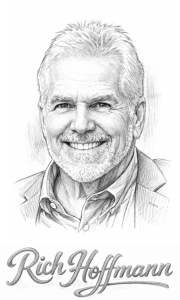
Richard Hoffmann (son of St. Louis)
- St. Louis born and raised in a huge German/Irish family … of a forest than a family tree
- Computer Science degree from the University of Missouri – Columbia (Mizzou)
- Two decades in the West Coast and Silicon Valley tech industry during its first hay day
- Technology collaboration leader in IBM, Informix Software, Documentum, and five technology start-up companies.
- Serial entrepreneur, architect, and innovator
- FACTORS Digital Intelligence and Veritas AI are Rich’s 9th and 10th start-up companies.
-
Boomeranged back to St. Louis to help make The Gateway City the epicenter of AI 2.0