
Could Clarity and Brainpower Become the New Popular Addiction?
We have a theory.
Think about the times when you’ve experienced what you would call, “euphoria” … that calm, light-hearted feeling of joy, peace, and satisfaction.
For most people a euphoric feeling usually arrives when:
- You get deeply engaged with a meaningful project
- A solution appears to a dilemma you’ve been wrestling with
- You’re enjoying carefree time with a good friend
- You think about someone or something you love
The problem with euphoria is that: it appears without notice, you can’t make it happen, and it typically leaves as fast as it came.
However, we believe we’ve discovered a way for euphoria to become much more regular … and predictable.
Our theory is about AIR, AI collaboration, and a path to euphoria without drugs or attention addictions.
First … we need to talk about something that isn’t euphoria. It’s actually the opposite, masquerading as if it is.
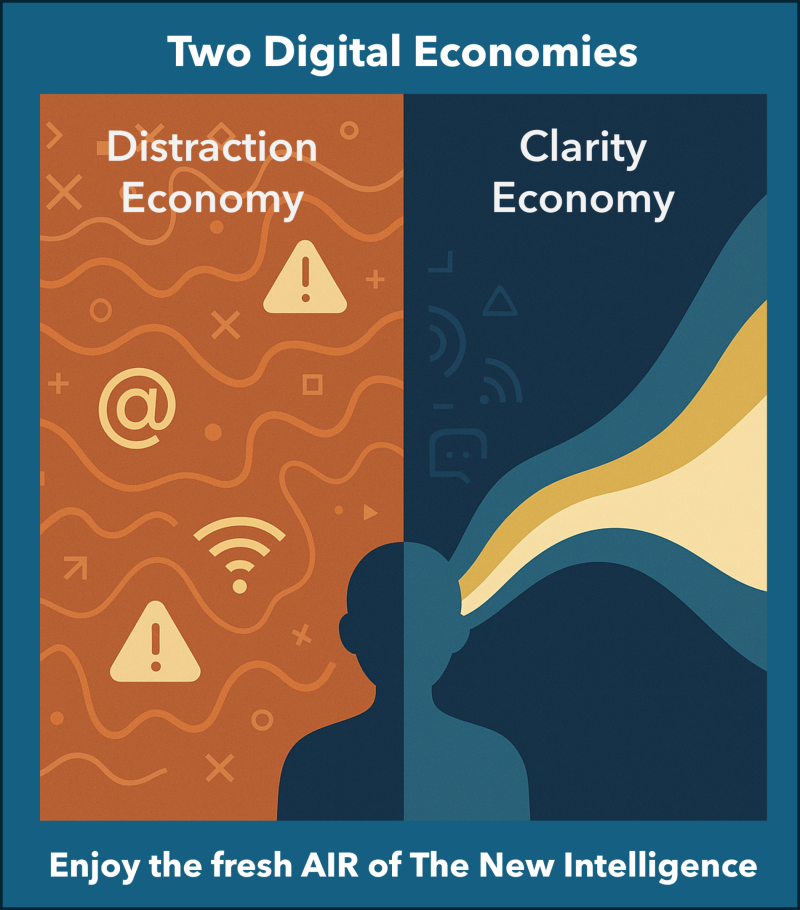
For the past twenty years, the digital economy has been built on and controlled by a simple principle:
Capture attention.
The more time people spend scrolling, clicking, reacting, refreshing, and trolling for “likes”, the more valuable the platform becomes.
Social media perfected this model.
- Infinite scroll.
- Alerts
- Notifications.
- “Like” theory
- Algorithmic novelty.
The result is an economy optimized for external stimulation.
But stimulation has a huge cost.
Many people now continually feel mentally exhausted, fragmented, and distracted. The same technologies that promised empowerment often leave us feeling scattered rather than sharpened.
Which raises an interesting question:
What if the opposite experience became the new digital reward?
What if the next great technology didn’t reward distraction?
What if it rewarded clarity and brainpower?
The Strange Emotional Reward of Thinking Clearly
Most people have experienced a small but powerful feeling when something suddenly makes sense.
- You’ve been wrestling with a problem.
- Then a structure emerges.
- The pieces align.
And instead of excitement, what you feel is something quieter:
- calm certainty
- intellectual satisfaction
- a sense that the direction is right
It’s not a thrill. It’s closer to relief mixed with insight.
Some people describe it as a moment of quiet euphoria.
Not loud. Not dramatic. But unmistakably good.
There is actually science and human chemistry behind that elusive state we call euphoria.
What If Technology Could Create More of Those Moments?
For decades, digital platforms have engineered systems that trigger dopamine through novelty, attention, and unpredictability.
But the human brain also produces the same powerful reward signals when it experiences:
- understanding
- progress
- pattern recognition
- meaning
In other words, our brains don’t only reward stimulation.
They also reward coherence.
And when coherence appears, something interesting happens:
- Confusion drops.
- Mental tension releases.
- Clarity emerges.
That moment often feels deeply satisfying … even euphoric.
A Different Kind of Feedback Loop
It is now well-known that most online systems operate on a purpose-driven reinforcement loop. Social Media companies, AI companies, game companies, and many smart phone app companies master the science of it.
That loop looks this:
Uncertainty → Novelty → Dopamine → Repeat
But imagine a different loop:
Confusion → Curiosity → Insight → Clarity → Reward → Continue
Same chemical reward system in our brains … entirely different result.
- Instead of keeping people scrolling, the system would encourage them to think better.
- Instead of fragmenting attention, it would focus it.
- Instead of stimulating the mind, it would align it.
Our Theory Behind AIR
At FACTORS Digital Intelligence, we have long been exploring, testing, and prototyping a new model of human–AI collaboration that we call AI-Ignited Resonance (AIR).
AIR is not designed to replace human thinking.
It is designed to amplify it.
When humans and AI collaborate well, something interesting happens:
- Ideas connect faster.
- Patterns become visible.
- Concepts lock into place.
- Thinking elevates.
The result is often a moment of calm recognition:
“That’s right.”
When this occurs repeatedly, people often report feeling energized rather than drained by thinking.
They want to continue exploring. Not because they are manipulated.
Because it feels good to make progress … especially in areas of thought and creativity that didn’t seem possible before.
Albert’s Elevator and the Clarity Loop
Inside the FACTORS Platform we’re developing an experience called Albert’s Elevator.
The idea is simple.
Each session helps a person work through a question, challenge, or idea using structured collaboration with AI.
Instead of providing instant answers, the process encourages:
- structured reasoning
- pattern recognition
- progressive clarity
- elevated thinking
The science is clear. When people reach a moment of understanding, our brains produce a small reward signal.
Not a rush. More like quiet satisfaction.
Many experts, as well as non-experts, describe that often brief experience as euphoria.
Over time, that creates a different relationship with technology.
Users begin returning not for distraction … but for clarity.
Could Clarity Become the New Popular Addiction?
That question might sound strange. But consider this:
Humans naturally repeat experiences that produce meaningful reward.
If a system consistently helps people experience:
- insight
- intellectual progress
- calm certainty
- Even sensations of euphoria
then engagement becomes natural.
Not because the platform traps attention.
Because it helps our minds function better.
A Healthier Form of Euphoria?
Modern dopamine loops often rely on addictive stimulation:
- gambling mechanics
- social media reactions
- outrage cycles
- endless novelty
But there is another kind of reward signal in the human brain.
The one that appears when:
- a puzzle is solved
- an idea becomes clear
- a path forward emerges
It’s a form of euphoria that doesn’t require substances or manipulation.
It simply requires alignment between effort and understanding.
Could AIR-enabled euphoria be the gateway drug to break the external stimulation addiction that has our culture and young people trapped?
We think it’s possible.
A Different Future for AI
Artificial intelligence is often discussed in terms of automation, capability, speed, and productivity.
But there may be another possibility.
AI could become a collaborative partner that helps humans experience more moments of clarity.
If that happens, digital technology might shift from:
Addictive attention … to … brainpower elevation
From distraction machines … to clarity engines.
That’s a different kind of economy for our precious brain resources.
Where We’re Placing Our Bets
We are so confident about this new future of intelligence that we built two companies and an entire Digital Intelligence and Ethical Intelligence architecture around it.
We’ve also defined a new field of science to explain and help shepherd it.
Because when clarity truly becomes rewarding, then technology might finally begin doing what it originally promised:
Making human thinking stronger rather than weaker and more addicted to distraction.
When that happens, a surprising cultural shift will likely follow. People might begin seeking not the next distraction …but the next moment when the fog lifts, brainpower is elevated and many paths become clear.
And that might be the most powerful digital experience of all.
To learn more about the science behind our theories, visit our Collaboration Science page on the FACTORS website.
👉 Insights in Collaboration Physics