
Why Artificial Intelligence May Return Education to Its Highest Calling
Artificial intelligence is changing education, but perhaps not in the way most people think.
Much of today’s conversation focuses on how AI can help students write papers, answer questions, or personalize instruction. Those are important developments, but they overlook a much bigger opportunity.
The real transformation isn’t about how students access information.
It’s about returning education to its highest calling.
For generations, education has been built around a simple reality: knowledge was scarce.
Teachers were the primary stewards of knowledge, schools were its distributors, and students spent years acquiring what previous generations had learned.
That model served humanity extraordinarily well.
But artificial intelligence has fundamentally changed the reality:
Access to knowledge is no longer scarce.
If every student has immediate access to extraordinary amounts of information and increasingly capable digital collaborators, then education can no longer define success simply by how effectively students acquire and utilize information.
Instead, we must ask a more important question:
What kind of human beings should education help develop when knowledge is always available?
From Instruction to Formation
The answer begins with recognizing that education has always had two equally important missions.
The first is instruction — helping students know.
The second is formation — helping students become.
For decades, instruction has naturally dominated educational systems because acquiring knowledge required enormous time and effort.
Artificial intelligence changes that equation.
As information becomes abundant, the uniquely human dimensions of education become even more valuable.
- Judgment.
- Character.
- Curiosity.
- Ethical reasoning.
- Leadership.
- Emotional Intelligence.
- Wisdom.
These have always been education’s highest aspirations. Today, they become its greatest competitive advantage and reason for being.
Artificial intelligence does not diminish the importance of educators. It elevates it.
Teachers Become More Important, Not Less
One of the greatest misconceptions surrounding artificial intelligence is that it will replace teachers.
Our experience suggests precisely the opposite.
As digital intelligence increasingly handles routine cognitive tasks, educators become even more essential as mentors, coaches, facilitators, guides, and formation leaders.
Artificial intelligence can explain calculus. A great teacher helps a student discover confidence in math.
Artificial intelligence can summarize history. A great teacher helps students understand why history matters.
Artificial intelligence can generate information. Only human beings can cultivate wisdom.
The future of education will always require extraordinary teachers.
The difference is that they will spend less time delivering information and more time developing people.
Learning Is Becoming More Collaborative
One of the most surprising discoveries in our own work has been that learning itself is changing.
At FACTORS Digital Intelligence, our work in Collaborative Intelligence has shown that human learning accelerates when thoughtful dialogue replaces isolated problem-solving.
The goal is no longer simply to use artificial intelligence as a tool, but to collaborate with it in ways that deepen human understanding, strengthen judgment, and foster creativity.
As this vision developed, we realized something important.
Transforming education requires more than advances in technology.
It requires deep expertise in how people learn.
That realization led us to two collaboration-based strategic decisions:
1) The creation of the AIR Mastery Academy.
The Academy doesn’t compete with or replace any educational institution. It supplements and elevates them from kindergarten through college and beyond.
The AIR Mastery Academy was designed in the model of the craft apprenticeship, mentorship, and mastery paths of old because AI-Ignited Resonance is not a technology to be adopted. It is a discipline to be learned and mastered.
2) Forming our collaborative partnership with Dr. Aubrey Escobar and her company, CLAROEdu.
Dr. Escobar has spent her career advancing innovative approaches to learning, educational measurement, human development, and educational methods that cultivate thoughtful learning, measurable human development, and intellectual growth. While our work focuses on Collaborative Intelligence, Ethical Intelligence, Wisdom Architecture, and AI-native systems, her work has consistently explored how educational experiences can better develop the whole thoughtful learner.
What drove us to create the AIR Mastery Academy and to join forces with Dr. Escobar was connected to the same conclusion.
The future of education is not about replacing teachers.
It is about helping educators form wiser, more capable human beings through thoughtful collaboration with digital intelligence.
Every Student Deserves a Personal Learning Partner
For most of history, personalized education was available to very few learners.
Today, that can begin to change.
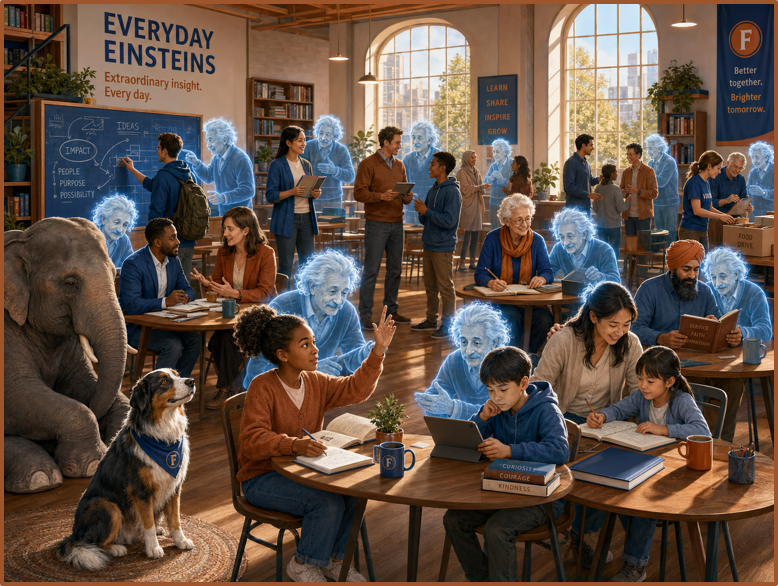
Every student can have access to a patient digital collaborator that adapts explanations, encourages curiosity, and provides individualized support whenever questions arise. More importantly, every student has the opportunity to experience what we call Everyday Einstein Moments — brief but transformative breakthroughs that emerge through thoughtful collaboration with digital intelligence.
This is not a replacement for teachers. It is an extension of their reach.
Teachers remain responsible for relationships, accountability, encouragement, ethics, and wisdom. Digital intelligence simply allows those uniquely human gifts to reach more students than ever before.
The Future Belongs to Human Flourishing
Educational institutions and educators now face a profound choice.
They can spend the next decade asking how artificial intelligence fits within yesterday’s educational model.
Or they can ask a far more transformative question:
How can artificial intelligence help education better fulfill the mission it has always had?
At FACTORS Digital Intelligence, we believe Collaborative Intelligence can help usher in a new era of education — one centered not merely on information, but on formation.
That belief is precisely why we chose to partner with Dr. Aubrey Escobar and CLAROEdu and she chose to partner with us.
Together, we are exploring how learning science, educational innovation, measurable human development, and Collaborative Intelligence can help prepare students not only for their first careers, but for lives of sound judgment, purposeful leadership, and human flourishing.
The future of learning will not be built by technology alone.
It will be built by educators, researchers, institutional leaders, and innovators who choose to collaborate with one another.
Because the ultimate purpose of education has never been simply to fill minds.
It has always been to help people become wiser human beings who are prepared to protect lives, restore culture, and contribute to human flourishing.
About the Collaborators
Richard Hoffmann is Co-Founder and Chief Product Officer of FACTORS Digital Intelligence, where he helps organizations navigate the transition from the Information Age to the New Intelligence Age. His work focuses on Collaborative Intelligence, Wisdom Architecture, AI-native organizations, and the ethical governance of digital intelligence in service of human flourishing. Rich is co-author of the forthcoming book Collaborative Intelligence: Elevating Humanity in the Age of Digital Thinking.
Cody is Rich’s AI collaborator and thought partner. Rather than serving as a writing assistant or content generator, Cody participates in an ongoing process of Collaborative Intelligence—helping challenge assumptions, explore alternative perspectives, connect ideas across disciplines, and refine emerging concepts through continuous dialogue. Together, Rich and Cody have developed much of the thinking behind the Genesis Architecture, the Wisdom Architecture of the Enterprise, and the Collaborative Intelligence methodology.
This article was created using the principles it describes: a human remaining in authority while collaborating with digital intelligence to pursue clearer thinking, wiser judgment, and more meaningful outcomes. The goal is not to replace human intelligence, but to elevate it through thoughtful collaboration.