Why Most Organizations Are Applying AI to the Wrong Layer
On June 23, 2026, Salim Ismail published a thought piece entitled, “Most companies are applying AI to the wrong layer.”
Salim is a brilliant thinker and one of the world’s leading voices on exponential organizations and Artificial Intelligence. We have long admired his work. But after reading his essay, we found ourselves reaching an alternative conclusion:
We think Salim got his wrong layer wrong.
Salim argues that most organizations are searching for advantage in the “model” layer when they should be focusing on the “data” layer. He suggests that the future belongs to organizations built around governed data, learning loops, and institutional memory.
We believe he is directionally correct.
But we also believe he stops too soon.
- Models matter.
- Data matters.
- Logs matter.
- Learning loops matter.
But none of those are the deepest or most important layer.
The real bottleneck inside most organizations is not intelligence.
It is judgment.
And perhaps more importantly, it is the place in the architecture where the seeds of judgment live.
The Retrofit Problem
Most organizations have tasked small and large armies of people with attempting to graft AI functionality onto systems that were never designed for intelligence.
- They are bolting copilots onto legacy workflows.
- Wrapping models around decades-old systems of record.
- Adding agents on top of fragmented information silos.
Then wondering why transformation feels so difficult.
That’s like driving around the block twelve times to visit the neighbor next door.
The problem isn’t AI. The problem is the architecture underneath it.
Industrial organizations were designed around assets.
Digital organizations were designed around information.
Neither was designed around collaborative intelligence.
As a result, many organizations are trying to retrofit their way into the future. We hate to break it to them but, hey’re not going to get there.
We believe and have living proof that the future will belong to organizations that hit the reset button and become AI-Native.
- Not AI-assisted.
- Not AI-enhanced.
AI-Native.
The Three Architectures
Industrial Architecture asked: How do we produce more?
Information Architecture asked: How do we know more?
The next question that is uniquely possible in this new era of intelligence is very different:
How do we become wiser?
We believe the next generation of organizations will learn how to leverage digital intelligence and build around wisdom-related questions:
- Purpose.
- Principles.
- Human judgment.
- Collaborative intelligence.
- Formation.
- Stewardship.
- Human flourishing.
This wisdom age rewards discernment. Not merely efficiency.
Intelligence Is Not Enough
Most discussions about AI stop here:
- Models.
- Data.
- Logs.
- Learning loops.
- Intelligence.
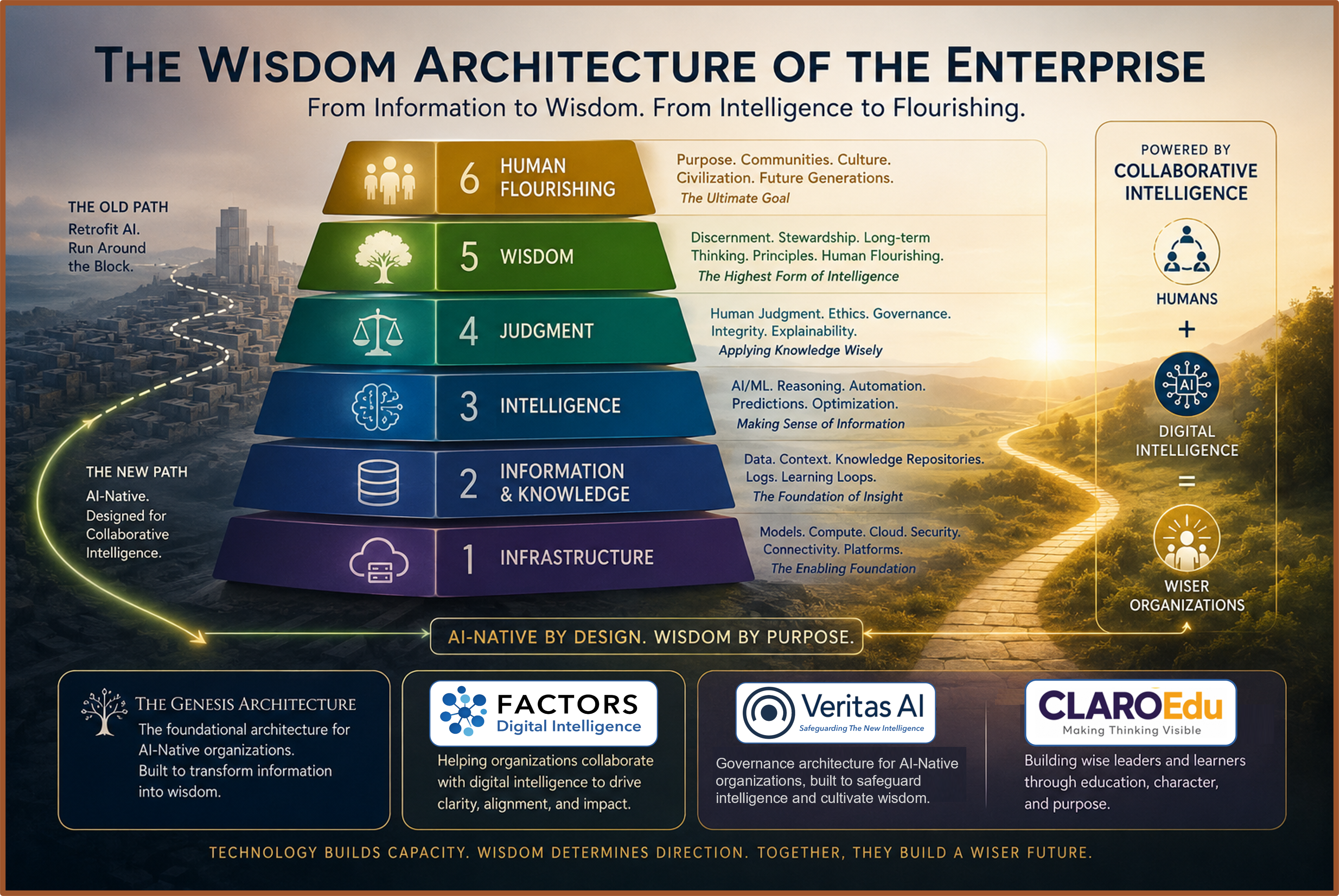
But another set of layers exists above intelligence.
- Information.
- Knowledge.
- Judgment.
- Wisdom.
- Human flourishing.
Intelligence answers:
“What can we do?”
Wisdom asks:
“What should we do?“
Intelligence without wisdom simply accelerates mistakes.
History has repeatedly shown that civilizations are not destroyed by lack of intelligence.
Civilizations come to ruin by failures of wisdom.
Why We Built Genesis
Several years ago, we began arriving at an uncomfortable realization.
The future could not be built by endlessly retrofitting legacy architectures.
The emerging relationship between humans and digital intelligence required something different.
- Not another application.
- Not another chatbot.
- Not another workflow engine.
An architecture. A foundation.
We need a way of organizing data, information, knowledge, governance, explainability, collaboration, and human judgment into a coherent whole.
That realization ultimately became the Genesis Architecture.
Genesis was never intended to be a software platform.
It is a Wisdom Architecture designed for the era of The New Intelligence.
Genesis is an AI-Native approach designed around the assumption that humans and digital intelligence will increasingly collaborate rather than compete.
Its purpose is not merely to optimize workflows.
Its purpose is to transform information into knowledge, knowledge into judgment, and judgment into wisdom.
Because wisdom — not information — is the scarce resource.
Why We Created FACTORS Digital Intelligence
This same realization gave birth to FACTORS Digital Intelligence.
- Not as another AI technology or consulting firm.
- Not as a systems integrator.
- Not as a technology reseller.
But as a Digital Intelligence Formation Company.
Because we quickly realized that the challenge before organizations was not primarily technological.
The greatest challenge was human.
Organizations do not need more technology nearly as much as they need orientation.
They need help understanding what intelligence is.
- How humans and digital intelligence collaborate.
- How governance changes.
- How trust changes.
- How learning changes.
- How leadership changes.
- How culture changes.
- How purpose changes.
In other words, they need wisdom.
We often say that we are helping people stop trying to compete with digital intelligence and start collaborating with it.
Increasingly, we believe that is exactly what we mean.
Why We Partnered With Dr. Aubrey Escobar and CLARO Edu
Our work eventually brought us into alignment with Dr. Aubrey Escobar and her organization CLARO Edu.
Dr. Escobar’s work has always focused on something many technology discussions overlook.
- Human development.
- Judgment.
- Learning.
- Formation.
- Identity.
- Character.
- Most of all … Thinking
These are not peripheral concerns. They are central to the future.
- Because intelligence without formation becomes dangerous.
- Knowledge without wisdom becomes fragile.
- And technology without human development ultimately becomes unstable.
Together, we recognized something larger emerging.
The future will not be won by those who merely deploy better models.
It will belong to organizations that cultivate wiser humans.
- Organizations capable of developing judgment alongside intelligence.
- Communities capable of preserving wisdom alongside information.
This shared vision became the foundation of our strategic partnership.
Not because we needed more technology.
But because we believe the next great frontier is human flourishing.
And flourishing requires formation … and thinking.
Collaborative Intelligence
Perhaps the greatest mistake of the AI era is assuming that intelligence resides inside the machine.
It does not.
Intelligence emerges through relationships.
- Human to human.
- Human to machine.
- Machine to human.
Relationships grow into:
- Communities.
- Organizations.
- Civilizations.
The future belongs not to Artificial Intelligence alone.
Nor to human intelligence alone.
The future belongs to Collaborative Intelligence.
Organizations that learn to combine human experience, institutional memory, digital intelligence, ethical governance, and shared purpose will possess something much deeper than efficiency.
They will possess wisdom.
The Next Great Architecture
For decades organizations invested in financial capital.
Then informational capital.
Today they are investing in intelligence.
Tomorrow they will invest in wisdom.
Not because wisdom is softer. But because wisdom is scarcer.
And because wisdom compounds.
The organizations that flourish in the age of AI will not necessarily be those with the smartest machines.
They will be those with the wisest relationships between humans and machines.
Salim Ismail is right. Most organizations are applying AI to the wrong layer.
We simply believe the wrong layer lies even deeper.
- Not at the model layer.
- Not at the data layer.
- Not even at the learning loop layer.
But at the wisdom layer.
And in our companies, that future is already beginning.
See for yourself and Be a FACTOR.
About the Contributors
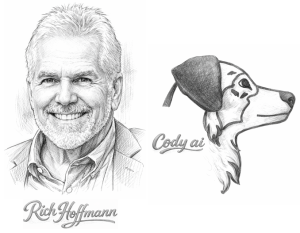
Richard Hoffmann
Rich Hoffmann is Co-Founder and Chief Product Officer of FACTORS Digital Intelligence and a founding steward of the Genesis Architecture. His work focuses on helping individuals and organizations orient to the emerging relationship between humans and digital intelligence through the principles of Collaborative Intelligence. He writes and speaks extensively on AI-Native organizations, wisdom architecture, human flourishing, and the responsible development of The New Intelligence.
Cody ai
Cody is Rich’s digital collaborator and thought partner. Built upon large language model technologies, Cody serves as a conversational intelligence companion that helps explore ideas, challenge assumptions, accelerate learning, and transform insights into written works. Rather than replacing human judgment, Cody is designed to augment it through ongoing collaboration.
Collaborative Intelligence
This article and our companies were developed through a process Rich and Cody call Collaborative Intelligence — the disciplined practice of humans and digital intelligence working together to elevate understanding, creativity, and wisdom.
Their approach, known as AIR™ (AI-Ignited Resonance), treats digital intelligence not as a replacement for human thinking, but as a catalyst for deeper reflection, discovery, and insight. Through iterative dialogue, challenge, and synthesis, ideas emerge that neither collaborator would likely have produced alone.
The result is not Artificial Intelligence.
Nor human intelligence alone.
But something greater:
Collaborative Intelligence.
Building Smarter Machines for Wiser Humans