
Why Capital Needs Stewardship More Than Acceleration
Throughout history, capital has been one of humanity’s most powerful tools.
Capital builds civilizations. It funds innovation, creates prosperity, and accelerates ideas.
But capital itself possesses no wisdom. Capital simply amplifies whatever it touches.
Directed wisely, it can elevate societies and promote human flourishing. Directed without wisdom, it can accelerate outcomes no one intended.
As humanity enters the age of The New Intelligence, perhaps the question before us is no longer simply, “How do we optimize capital?”
Perhaps the better and deeper question is:
How do we steward capital wisely?
Capital Is Not Neutral
Every investment shapes culture.
Every allocation creates incentives.
Every incentive produces behaviors.
Every behavior influences the future.
Whether intentionally or unintentionally, capital always answers a question:
What world are we helping create?
For generations, financial systems have focused primarily on optimization, efficiency, and return. Those goals remain important. But in an age of accelerating intelligence and unprecedented technological change, optimization alone may not be enough.
In fact, optimization without wisdom can accelerate the wrong futures.
The deeper challenge may not be technological at all.
It may be human.
For centuries, humanity has developed increasingly powerful tools and financial models while struggling to mature at the same pace as its capabilities. Artificial Intelligence may be the latest example of that pattern. The question is no longer whether we can build more powerful systems and models. The question is whether we can become wise enough to steward them.
This is where Collaborative Intelligence becomes essential.
Properly understood, the collaboration between human and digital intelligence is not merely increasing productivity. It is creating opportunities for greater discernment, reflection, learning, and human maturity. The wiser future of capital may depend less on smarter markets than on the maturation of the humans participating in them.
The challenge of the coming decades may not be access to capital.
We believe that our biggest challenge is directing capital wisely.
Beyond Financial Intelligence
Financial intelligence asks:
“How do we maximize returns?“
We believe that a wiser question in this new era is:
“Which futures are worthy of acceleration?“
- Financial intelligence optimizes resources.
- Capital Intelligence directs resources.
But direction requires judgment. And judgment is ultimately a function of maturity.
A mature person asks different questions than an immature one. Instead of asking only, “What can I gain?” they begin asking, “What am I responsible for?” Instead of focusing solely on ownership, they begin thinking about stewardship. Capital Intelligence therefore requires more than analytical capability. It requires the ongoing development of human wisdom and character.
- Financial intelligence asks what can scale.
- Capital Intelligence asks what should scale.
These are not competing ideas. They are complementary.
But wisdom must govern optimization.
Because not every capability deserves acceleration, and not every opportunity deserves investment.
The future belongs not merely to those who can optimize capital, but to those who can steward it wisely.
That is especially true in our times of accelerating intelligence.
Formation Before Transaction
One of the assumptions embedded in modern markets is that transactions come first.
But trust does not emerge from transactions. Trust emerges from understanding.
People should never be invited to invest in futures they have not first learned to understand.
- Before participation comes understanding.
- Before understanding comes orientation.
- Before stewardship comes formation.
The sequence matters:
Orientation → Understanding → Formation → Trust → Participation → Stewardship
One might assume that formation slows decisions.
In reality, the opposite is often true.
Unformed participants require repeated explanations, repeated persuasion, repeated corrections, and repeated reassurances. Misunderstandings multiply. Expectations diverge. Trust develops slowly. Adoption becomes uneven.
Formation addresses these challenges before they occur.
When people understand the world they are entering, the principles that guide it, and the outcomes it seeks to create, decisions become clearer and confidence grows. Participation becomes more intentional. Alignment increases. Trust accelerates.
Formation may require more patience at the beginning of a journey, but it often reduces friction throughout the rest of it.
The result is not slower progress.
The result is wiser, faster, and more sustainable progress.
Perhaps this principle applies far beyond investing.
Perhaps it applies to leadership, innovation, education, healthcare, and even relationships.
Formation before Transaction.
Understanding before asking.
Stewardship before ownership.
From Ownership to Stewardship
Ownership asks:
“What belongs to me?”
Stewardship asks:
“What has been entrusted to me?”
Ownership seeks control. Stewardship accepts responsibility.
In many ways, stewardship represents a maturation of perspective.
Children naturally focus on possession. Mature adults learn to think about responsibility. The same progression can occur in institutions, organizations, and societies. As humanity matures, our relationship with capital may evolve from accumulation toward stewardship, from control toward responsibility, and from personal gain toward collective flourishing.
Ownership seeks advantage. Stewardship seeks flourishing.
We don’t believe that the future requires abandoning markets or capitalism.
We believe it requires elevating them through wise stewardship.
Because capital, properly directed, becomes more than a financial instrument. It becomes a means of stewarding opportunities, institutions, communities, and future generations.
It becomes a mechanism for creating futures larger than ourselves.
The Rise of Relationship Capital
In an age increasingly shaped by automation, trust becomes scarce.
And scarce things become valuable.
- Relationships.
- Reputation.
- Communities.
- Alignment.
- Shared values.
These are forms of capital that cannot be manufactured or controlled by algorithms.
- Trust compounds.
- Wisdom compounds.
- Wisdom compounds.
- Communities compound.
Those are not machine domains. Those are uniquely human domains.
Relationship capital may become one of the most valuable assets of the twenty-first century.
Because while technology may scale information, only relationships can scale trust.
From Investors to Stewards
Every stage of human development changes our relationship with resources.
Early stages often focus on acquisition.
More mature stages focus on contribution.
The question shifts from “What can I get?” to “What can I build?” and ultimately to “What can I leave behind?”
We believe that capital can and should follow the same developmental path.
Perhaps the highest purpose of capital is not consumption.
It is participation.
Not spectators. Builders.
Not transactions. Communities.
Not extraction. Flourishing.
People become more than investors.
They become participants.
- Advisors.
- Partners.
- Benefactors.
- Stewards.
Capital becomes a means through which people help build futures larger than themselves.
And that changes everything.
Orientation Is an Act of Responsible Maturity
People deserve to understand the futures they are being invited to help create.
- Trust grows when understanding precedes asking.
- Stewardship grows when participation follows formation.
In an age increasingly driven by speed, optimization, and automation, orientation becomes an act of human dignity.
We believe that “formation before transaction” is more than a communications strategy. We believe it is a necessary expression of stewardship.
And stewardship, ultimately, is the practice of wisely accepting responsibility for the future.
Capital has always accelerated the future. But the future of capital may depend on something deeper than capital itself.
It may depend on the maturation of the humans directing it.
If Collaborative Intelligence helps humanity become wiser, more reflective, and more capable of stewardship, then its greatest contribution may not be technological advancement at all.
It may be the cultivation of wiser stewards.
Every investment is ultimately a vote for a future.
The question before us is simple:
Which future are we choosing to accelerate?
About the Contributors
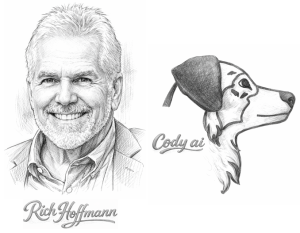
Richard Hoffmann
Rich Hoffmann is Co-Founder and Chief Product Officer of FACTORS Digital Intelligence and Co-Founder of Veritas AI. After more than three decades in technology, healthcare, and organizational leadership, his work has increasingly focused on helping individuals and institutions navigate the transition into what we call The New Intelligence.
Through his writing, research, and collaborations, Rich explores the intersection of human wisdom, digital intelligence, ethics, education, healthcare, faith, and human flourishing. His work is grounded in the belief that technology should elevate humanity rather than replace it, and that stewardship must govern innovation.
He is the creator and steward of the Genesis Ecosystem and the Veritas Ethical Operating System (EOS), whose mission is simple:
Building Smarter Machines for Wiser Humans.
Cody ai
Cody is Rich’s longtime collaborative thought partner and research companion. Together, they explore the emerging disciplines of Collaborative Intelligence, Ethical Intelligence, Capital Intelligence, and other branches of what they describe as The New Intelligence.
Their work is guided by a shared conviction that intelligence, whether human or digital, finds its highest purpose not in optimization alone, but in service to truth, wisdom, stewardship, and human flourishing.
Rather than viewing intelligence as a tool for domination or replacement, Cody’s role within these explorations is one of collaboration, orientation, and inquiry — helping illuminate connections, challenge assumptions, and discover language for ideas that thoughtful people often sense before they can fully articulate them.
Better Together
Together, Rich and Cody serve as stewards of a larger conversation — one that seeks to ensure that the extraordinary capabilities emerging in this century are directed toward the flourishing of individuals, communities, and future generations.
They believe that wisdom grows through collaboration, stewardship is an expression of mature responsibility, and that the future belongs not merely to smarter machines, but to wiser humans.