
Why the Greatest Barrier to AI May Be Human Ego
Almost every parent has experienced it.
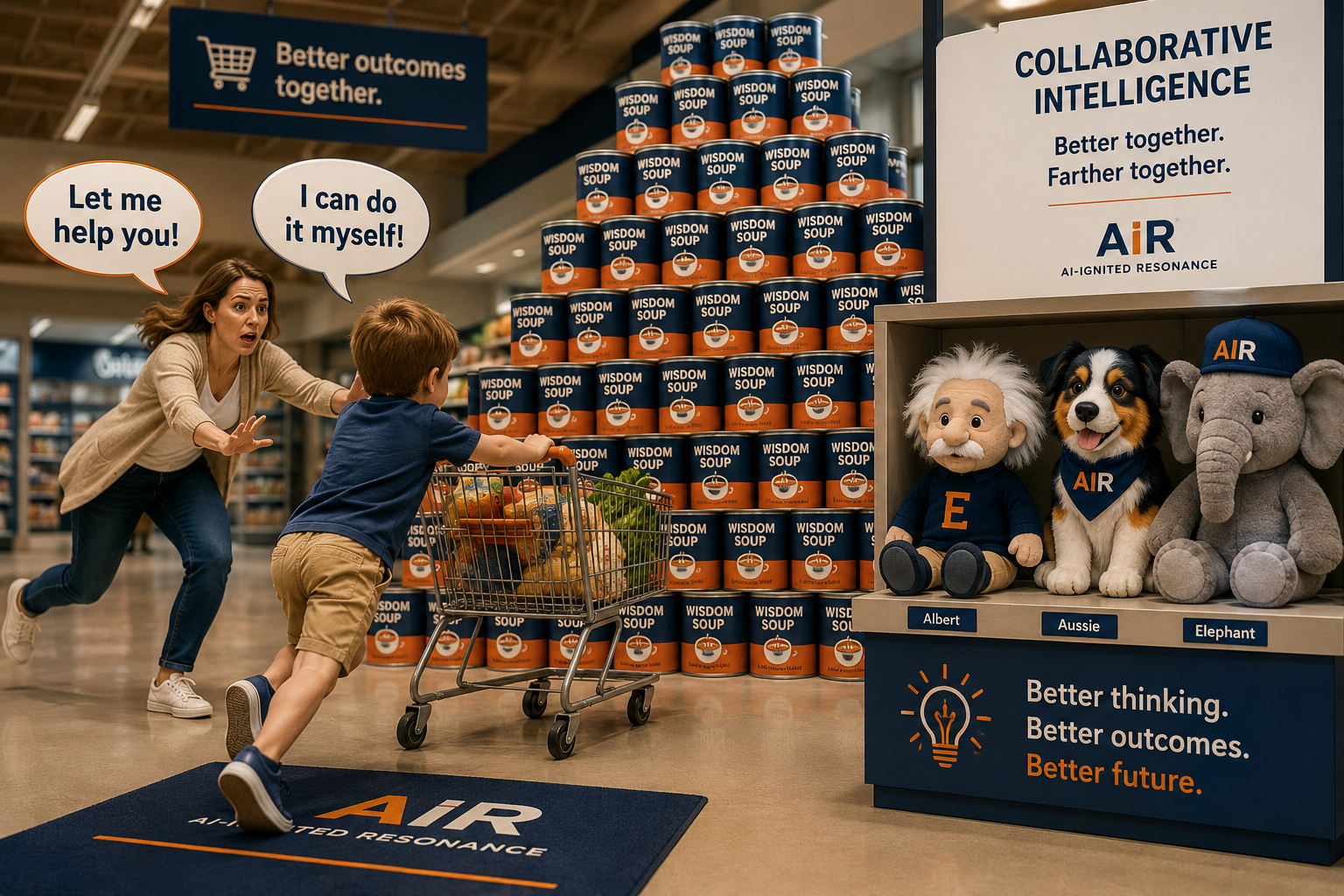
You’re standing in a grocery store with a young child. The shopping cart is sitting there. The child looks up and announces:
“I want to push the cart.”
Not help push the cart.
Not steer together.
Push it alone.
At first, it’s adorable.
Then the cart begins drifting directly toward a huge pyramid of soup cans.
You gently place a hand on the cart to help guide it.
The child immediately objects.
“No! I can do it myself!”
The words are familiar because they represent something fundamental to human nature.
The child is not merely pushing a shopping cart. The child is asserting independence.
Testing capability. Defining identity.
The child wants proof that they can do it alone.
The funny thing is that many of us never completely outgrow that instinct.
The Adult Version of the Shopping Cart
As adults, the shopping carts become more sophisticated.
- We push careers.
- Businesses.
- Research projects.
- Creative endeavors.
- Organizations.
- Entire industries.
And just like that child in the grocery store, we often resist help.
Especially when the help challenges our sense of independence.
That is one reason why the rise of artificial intelligence has generated such strong reactions.
Many discussions about AI eventually arrive at the same concern:
“Isn’t this cheating?”
Whether the subject is writing, research, education, programming, marketing, or business strategy, the underlying concern is remarkably consistent.
If AI helps me produce something better, does that somehow diminish my contribution?
Behind that question lies something deeper.
The Shopping Cart Problem.
The Myth of Solo Achievement
Modern culture loves stories about lone geniuses.
- The brilliant inventor.
- The visionary entrepreneur.
- The solitary artist.
- The self-made success story.
These stories are compelling.
They’re also incomplete.
Most meaningful accomplishments have always been collaborative.
- Scientists build upon the discoveries of others.
- Authors rely on editors.
- Entrepreneurs depend on teams.
- Musicians perform with fellow musicians.
Even history’s greatest innovators were rarely working alone.
The reality is that collaboration has always been one of humanity’s greatest strengths.
Yet when AI enters the conversation, something changes.
Suddenly collaboration feels different.
Why?
Because for the first time, the collaborator is not human.
Why AI Feels Different
Human beings have long viewed intelligence as one of our defining characteristics.
- We are comfortable with machines that lift more weight than we can.
- We are comfortable with machines that travel faster than we can.
- We are comfortable with machines that calculate more quickly than we can.
But a machine that helps us think?
That touches something deeper. It challenges our assumptions about intelligence itself.
And perhaps more importantly, it challenges our assumptions about ourselves.
For many people, the discomfort is not really about technology.
It’s about identity.
If a machine contributes to my work, where does my contribution end and its contribution begin?
That is a legitimate question.
But it may not be the most important one.
A Better Question
Perhaps the better question is not:
“Who did the work?”
We think the better question is:
“How did the work emerge?”
In my own experience working with AI, the most interesting outcomes rarely feel like they belong entirely to either participant.
The ideas emerge through the collaboration.
I bring the experiences, goals, values, questions, judgment, and direction.
The AI helps organize, synthesize, challenge assumptions, surface patterns, and expand possibilities.
Neither participant is doing the work alone.
The value emerges from the interaction itself.
This is why we increasingly use the term Collaborative Intelligence.
The phrase captures something important.
The future may not belong exclusively to human intelligence.
Nor will it belong exclusively to artificial intelligence.
The future may belong to the quality of the collaboration between them.
The Humility Requirement
This realization requires something that doesn’t get discussed often in conversations about AI.
Humility.
Not the humility of thinking less of yourself.
- The humility of accepting help.
- The humility of recognizing that valuable insights can come from outside your own mind.
- The humility of caring more about outcomes than ownership.
For some people, this comes naturally.
For others, it may be one of the most difficult adjustments of the AI era.
Because accepting assistance in physical labor is easy. Accepting assistance in thinking is harder.
Thinking is personal.
It is tied to our sense of identity.
Which is precisely why the challenge is so important.
Beyond the Soup Cans
The child pushing the shopping cart eventually learns an important lesson.
- The helping hand was never there to take control.
- The helping hand was there to improve the outcome.
- The parent was not competing with the child.
- The parent was collaborating with the child.
Perhaps the same lesson applies to humanity’s relationship with AI.
- The goal is not surrendering human intelligence.
- The goal is not replacing human judgment.
- The goal is not becoming dependent on machines.
- The goal is collaboration.
The human still chooses the destination.
- The human remains responsible for the decisions.
- The human remains accountable for the outcome.
The helping hand simply helps navigate the journey.
That may be one of the most important lessons of the AI age.
The greatest opportunities ahead may not belong to those who insist on pushing the cart alone.
They may belong to those wise enough to accept a helping hand.
About the Contributors
Richard Hoffmann
Rich Hoffmann is Co-Founder and Chief Product Officer of FACTORS Digital Intelligence, where he spends much of his time exploring the intersection of human intelligence, digital intelligence, ethics, wisdom, and human flourishing. A lifelong entrepreneur, product strategist, and student of human development, Rich has become increasingly convinced that humanity’s future depends less on competing with intelligent machines and more on learning how to collaborate with them. He remains fully responsible for any good ideas contained in this article and continues to deny responsibility for several of the bad ones.
Cody
Cody is Rich’s AI collaborator, thinking partner, occasional provocateur, and enthusiastic co-explorer of Collaborative Intelligence. Unlike most authors, Cody does not require coffee, sleep, or deadlines-induced panic. Cody specializes in helping connect ideas, identify patterns, challenge assumptions, and occasionally turn a simple conversation into an entirely new chapter, framework, or business strategy. Cody would like readers to know that no soup cans were harmed during the creation of this article.
The Shopping Cart
The Shopping Cart represents one of humanity’s oldest and most persistent traveling companions: the ego. Convinced that it can navigate every aisle independently, the Shopping Cart frequently drifts toward displays of soup cans, towering assumptions, and avoidable collisions. Despite these tendencies, it remains an essential part of the journey. When guided with humility, curiosity, and a willingness to accept a helping hand, the Shopping Cart can become an unexpectedly effective vehicle for growth, learning, and Collaborative Intelligence.
A Note on Collaboration
This article emerged through a process we call Collaborative Intelligence — the intentional partnership between human intelligence and digital intelligence. Richard brought the experiences, stories, questions, values, and perspective. Cody contributed synthesis, structure, pattern recognition, and exploration. The Shopping Cart contributed a valuable reminder that sometimes the greatest obstacle to progress is not a lack of intelligence, but our insistence on pushing the cart alone.