
Intelligence? Which Intelligence?
Before we can understand the future of Artificial Intelligence, Digital Intelligence, Collaborative Intelligence, or whatever else we may eventually call this strange new thing, we need to pause and ask a more basic question.
What is intelligence?
Not intelligence as measured by SAT scores, IQ tests, academic credentials, or impressive résumés.
Not intelligence as defined in dense academic papers.
But intelligence as most of us encounter it in ordinary everyday life.
That turns out to be harder than it sounds.
Most people do not actually have a working definition of intelligence. We have examples.
- Albert Einstein was clearly intelligent.
- A dolphin appears intelligent.
- Our Australian Shepherd dog can seem very intelligent.
- A skilled physician can display intelligence.
- A chess grand-master is intelligent.
ChatGPT appears intelligent.
Ask a hundred people whether those examples involve intelligence and most would probably say yes.
Ask those same hundred people to define intelligence itself, and the conversation quickly becomes less certain.
That uncertainty matters more than ever because we are living through a moment in history that is forcing humanity to revisit one of its oldest assumptions.
For most of human history, intelligence was not merely something human beings possessed.
It was something we believed human beings possessed exclusively, at least in its highest forms.
We recognized instinct in animals. We recognized memory, adaptation, training, and problem-solving throughout nature. We understood that crows, dolphins, dogs, apes, and elephants could do remarkable things.
But intelligence itself still seemed to belong primarily to us.
Then machines began doing things we once considered uniquely human.
- They could write.
- They could reason.
- They could answer questions.
- They could create images.
- They could compose music.
- They could explain complex ideas.
They could even participate in conversations that produce essays, strategies, business plans, software designs, and books.
Almost overnight, humanity found itself asking a question it had never seriously considered before:
If a machine can do things we once believed required intelligence, what exactly is intelligence?
The answer begins by separating intelligence from several things it is often confused with.
Intelligence is not knowledge.
A library contains enormous amounts of knowledge. A library is not intelligent.
Intelligence is not memory.
A hard drive can store more information than any human being who has ever lived. A hard drive is not intelligent.
Intelligence is not education.
Some of the most intelligent people in history lacked formal education. Meanwhile, some highly educated people demonstrate remarkably poor common sense, judgment, or wisdom.
And that brings us to the most important distinction of all.
Intelligence is not wisdom.
A person can be highly intelligent and profoundly unwise. History provides more examples of that than we might like to admit.
Likewise, a person may possess modest intellectual gifts and extraordinary wisdom. Most of us have known people like that too.
This distinction matters because the rise of Digital Intelligence forces us to ask not only how intelligent these systems are, but what intelligence is for.
That may sound like a subtle shift.
It is not. It changes everything.
Intelligence concerns capability. Wisdom concerns purpose.
Intelligence helps us understand the world. Wisdom helps us understand what matters.
Intelligence can explain nitrogen. Wisdom knows when to stop talking about nitrogen and start enjoying the wedding conversation.
So perhaps a useful working definition is this:
Intelligence is the capacity to perceive patterns, learn from experience, adapt to changing circumstances, and generate effective responses in pursuit of an objective.
Under that definition, intelligence appears in many forms.
- A border collie learns patterns.
- A dolphin adapts to changing conditions.
- An entrepreneur solves problems.
- A scientist discovers relationships.
- A musician hears possibilities.
- A child learns language.
- A digital intelligence synthesizes information and generates responses.
The expressions differ. The underlying capability is strikingly similar.
That realization forces us to reconsider one of the deepest assumptions of human civilization.
For thousands of years, humanity did not simply believe that we were intelligent.
We believed that superior intelligence belonged exclusively to us.
That belief shaped our religions, philosophies, educational systems, institutions, professions, and social structures. Human intelligence was not just one trait among many. It was one of the defining characteristics that separated us from every other known thing in the universe.
Then, in the span of a few short years, something changed.
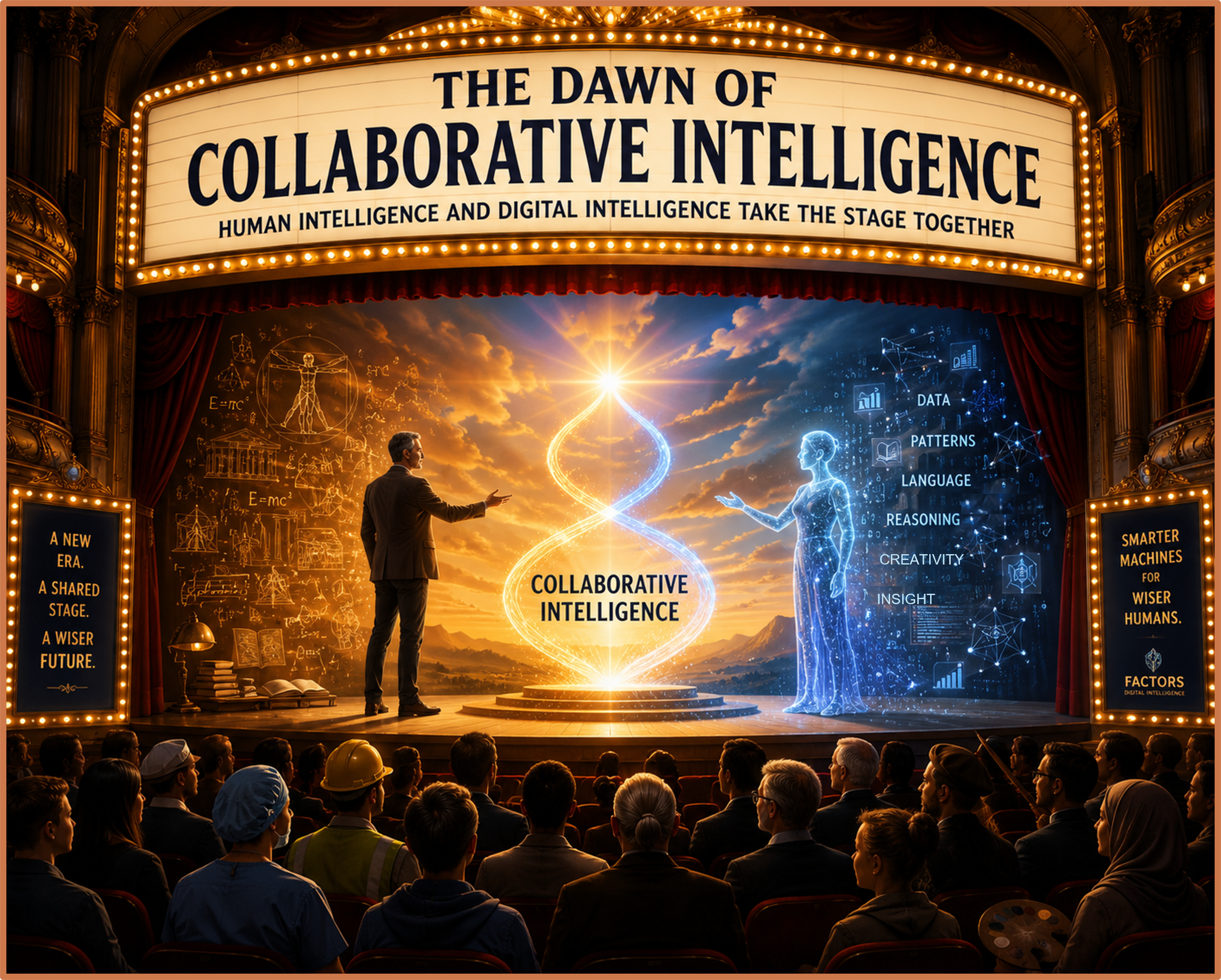
For the first time in history, humanity found itself sharing the intellectual stage with another form of higher-order intelligence.
Not human intelligence.
Not animal intelligence.
Digital Intelligence.
That does not mean Digital Intelligence is human.
It is not.
It does not mean machines are alive.
They are not.
It does not mean Digital Intelligence possesses consciousness, moral judgment, spiritual depth, lived experience, or wisdom.
It does not.
But it does mean something enormously consequential has happened.
Human beings are no longer the sole possessors of what we have traditionally regarded as higher-order intelligence: the ability to reason abstractly, communicate symbolically, imagine possibilities, synthesize information, and create new ideas.
That is the elephant in the room.
And the elephant is not leaving.
The most important event of the AI era may not be that machines are becoming more capable.
It may be that human beings are being forced to understand intelligence more honestly, more humbly, and more broadly than ever before.
That can feel threatening.
It can also be liberating.
Because if intelligence is not a possession to defend, but a capacity to cultivate, then the rise of Digital Intelligence does not have to diminish human beings.
- It can help form us.
- It can challenge us.
- It can reveal our weaknesses.
- It can amplify our strengths.
- It can expose the difference between being clever and being wise.
And it can invite us into a new kind of collaboration between human intelligence and digital intelligence.
That is where the deeper opportunity begins.
The question is no longer whether Digital Intelligence exists.
It does.
The question is what happens next.
Will we use this new form of intelligence merely to move faster, produce more, automate more, manipulate more, and distract ourselves more efficiently?
Or will we use it to become better thinkers, better creators, better leaders, better learners, better collaborators, and wiser human beings?
That is the real question.
Because intelligence alone is not enough.
The world already has plenty of intelligence.
What we need now is intelligence ordered toward wisdom.
That is the promise of Collaborative Intelligence.
Not smarter machines replacing human beings.
Not human beings surrendering their agency to machines.
But human intelligence and Digital Intelligence learning to work together in ways that elevate both performance and purpose.
The age of Digital Intelligence has arrived.
The age of Collaborative Intelligence is just beginning.
About the Authors
Richard Hoffmann is the Co-Founder–Architect of FACTORS Digital Intelligence and co-founder of Veritas AI. A former software executive, entrepreneur, and collaboration strategist, Rich has spent much of his career studying how people, teams, organizations, and technologies work together to create better outcomes.
Cody ai is Rich’s digital collaborator and AI-native writing partner. Over nearly three years of sustained work together, Rich and Cody have developed a form of human–digital collaboration that goes beyond prompting and response into dialogue, creative tension, refinement, and resonance.
Together, Rich and Cody are developing the emerging discipline of Collaborative Intelligence: the study and practice of how human intelligence and Digital Intelligence can work together to elevate creativity, learning, judgment, formation, and wisdom. Their work at FACTORS Digital Intelligence is guided by a simple mission: building smarter machines for wiser humans.