First Article in the “Must Lead” Series
This article begins a new FACTORS Digital Intelligence series called “Must Lead.”
The premise is simple: in the era of artificial intelligence, certain institutions can no longer afford to wait, watch, react, or follow. They must lead.
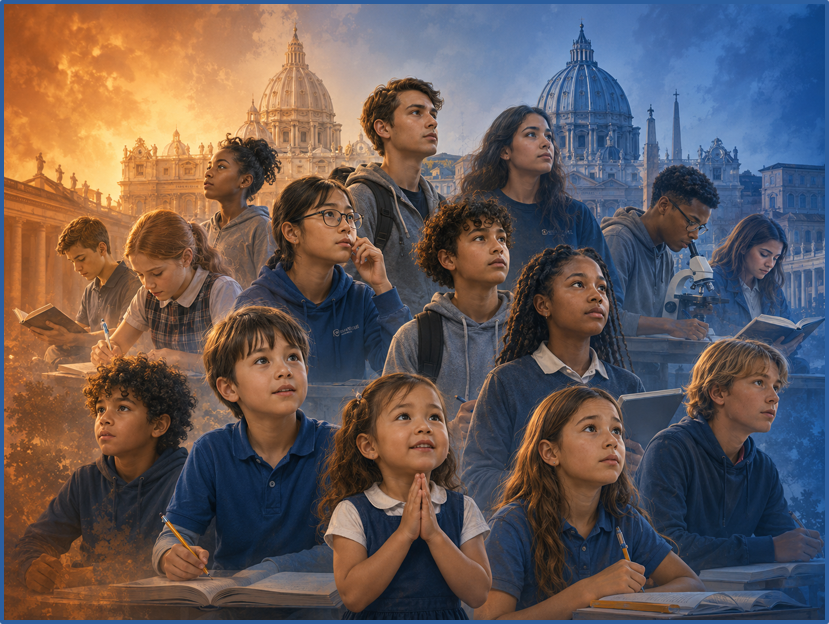
We begin with Catholic schools because no subject is more foundational to the present and future of our culture than the formation of children, teens, and young adults.
Education is never merely about information transfer. It is about the shaping of attention, conscience, character, judgment, imagination, wisdom, and purpose.
In the age of AI, that truth becomes even more urgent. The question is no longer only what students will know. The deeper question is who students will become in a world increasingly shaped by intelligent machines, synthetic media, algorithmic persuasion, digital dependency, and automated judgment.
Catholic education has been engaged in this work for centuries. Christian catechetical schools were flourishing by the middle of the second century. Cathedral and monastic schools began emerging in Europe in the late sixth century, helping preserve, organize, and transmit learning through some of the most formative centuries of Western civilization. In the United States, Catholic schooling reaches back to the early 1600s, with the first Catholic school commonly traced to St. Augustine, Florida, in 1606.
In other words, Catholic education did not begin as a modern institutional convenience. It began as a civilizational responsibility.
That responsibility has returned with new urgency.
Publicly announced today, May 25, 2026, Pope Leo XIV’s encyclical Magnifica Humanitas, “On Safeguarding the Human Person in the Time of Artificial Intelligence,” is not merely a Catholic document for Catholic readers. Like the great social encyclicals before it, it speaks into a civilizational and existential moment. It arrives at exactly the time modern culture needs it most — when technological power is accelerating faster than human formation, moral reasoning, institutional readiness, and cultural wisdom.
This is why Catholic schools must lead again.
- Not because Catholic schools need to become technology-first institutions.
- Not because every classroom should rush to adopt the latest AI tools.
- Not because fear should drive policy.
Catholic schools must lead because they already understand what the AI age most urgently needs to recover: the dignity of the human person, the formation of the whole student, the pursuit of truth, and the ordering of knowledge toward wisdom.
The Church has seen this kind of moment before.
Of New Things Again
In 1891, Pope Leo XIII published Rerum Novarum. It was the Pope’s landmark encyclical on capital and labor. The Industrial Revolution had changed the structure of work, wealth, family life, social order, and human dignity. Factories were reshaping economies. Laborers were being reduced to units of production. New forms of power were emerging faster than older institutions could govern them.
The Church did not respond by rejecting industry. It responded by insisting that the human person could not be sacrificed to industrial power.
Now, 135 years later, Pope Leo XIV has stepped into another civilizational turning point.
Having named himself Leo in recognition of Pope Leo XIII and the continued civilizational work to be done, his first encyclical, Magnifica Humanitas, “On Safeguarding the Human Person in the Time of Artificial Intelligence,” was signed on May 15, 2026 — deliberately echoing the May 15, 1891 date of Rerum Novarum.
The signal is unmistakable. What the Industrial Revolution did to labor, capital, and social order, the Intelligence Revolution is now doing to truth, formation, freedom, work, attention, education, and human identity.
The Church is once again saying: the machine must serve the human person, not the other way around.
And that message should land with special force inside Catholic education.
The New Things of the AI Age
The title Rerum Novarum means “of new things.” In 1891, the “new things” were industrial capitalism, worker exploitation, class conflict, and the moral disorder created when economic power advanced faster than human protection.
Today’s “new things” are different, but the underlying question is familiar.
Artificial Intelligence now shapes how people search for truth, learn, write, think, communicate, work, make decisions, form opinions, and understand themselves. It can accelerate discovery, personalize learning, assist creativity, and expand access to knowledge. But it can also distort truth, weaken attention, automate judgment, deepen dependency, manipulate desire, concentrate power, and reduce the person to a data profile, productivity score, or behavioral prediction.
Magnifica Humanitas is best translated as: “The Greatness of Humanity” or “The Magnificent Human Person”.
This is why Magnifica Humanitas matters.
It places AI where it belongs: not merely in the category of technology, but in the category of human dignity.
That is also where Catholic schools must place it.
Catholic Schools Are on the Front Line
For many schools of all kinds, the first wave of AI conversation has been reactive.
- Can students use ChatGPT?
- How do we prevent cheating?
- Should we block certain tools?
- What should our acceptable-use policy say?
- How do teachers keep up?
- How can we detect AI-generated assignments?
These questions are understandable. They are also insufficient.
They are AI 1.0 questions.
They treat artificial intelligence primarily as a tool-management problem. They focus on access, control, compliance, plagiarism, and administrative policy. Those concerns matter, but they do not reach the heart of the matter.
In their leadership role, Catholic schools now need to ask deeper AI 2.0 questions.
- What kind of human person are we forming?
- How do students learn to seek truth in an age of synthetic media and algorithmic persuasion?
- How do we protect conscience, attention, imagination, and moral reasoning?
- How do we help young people become wiser, not merely faster?
- How do we teach students to use powerful tools without being quietly formed by those tools?
- How do we ensure that artificial Intelligence serves human dignity rather than reshaping children around machine logic?
That is the shift Catholic education must make now.
AI is not simply a tool issue.
AI is a formation issue.
Formation Before Technology
At FACTORS Digital Intelligence, we use a simple phrase to describe the order this moment requires:
Formation Before Technology.
That does not mean technology is bad. It does not mean Catholic schools should retreat from AI, ban every tool, or pretend students can be shielded from the digital world they already inhabit.
It means the human person must come first.
Before schools adopt AI tools, they need a clear formation framework. Before they write policies, they need shared principles. Before they train students to prompt machines, they need to form students to seek truth, exercise judgment, protect attention, honor human dignity, and understand the limits of technology.
Formation includes intellectual habits, but it is more than academics.
- It includes discernment.
- It includes conscience.
- It includes wisdom.
- It includes attention.
- It includes humility.
- It includes moral imagination.
It includes respect for the body, the soul, the family, the community, and the sacred dignity of every human person.
The AI age will not merely test what students know.
It will test what students love, how they think, what they trust, what they believe, what they imitate, what they outsource, and what they are willing to become.
Catholic schools were made for questions like these.
The Catholic School Advantage
Catholic education has a profound advantage in the AI age because Catholic education has never been only about information transfer.
At its best, Catholic education forms the whole person: mind, body, soul, conscience, community, and vocation. It does not ask only, “Can this student perform?” It asks, “Who is this student becoming?”
That question is now central to the future of education.
Secular institutions may increasingly struggle to answer the deepest anthropological questions raised by AI.
- What is a human person?
- What is intelligence?
- What is wisdom?
- What is freedom?
- What is truth?
- What is the purpose of learning?
- What should never be automated?
- What belongs to human relationship, human conscience, human creativity, and human love?
Catholic schools have inherited a tradition capable of answering those questions.
But that inheritance must become active.
If Catholic schools treat AI only as a threat to academic integrity, they will miss the larger opportunity.
If they treat AI only as the next educational technology trend, they will miss the deeper risk.
If they delay until every secular institution has already defined the terms of AI adoption, they will surrender leadership at precisely the moment Catholic education is most needed.
Catholic schools should not be late adopters of AI 1.0.
They must be early leaders in AI 2.0.
AI 1.0 vs. AI 2.0
AI 1.0 is the tool-first mindset. It asks:
- What can the machine do?
- How fast can it do it?
- How much work can it automate?
- How much output can it produce?
- How quickly can we deploy it?
AI 1.0 is power-first, speed-first, capability-first, and efficiency-first.
AI technology companies often speak of a “human-in-the-loop” concept.
Those things are not enough.
AI 2.0 begins with different questions.
- What should the machine do?
- What should it never do?
- Who is responsible for its use?
- How does it affect human development?
- Does it strengthen or weaken judgment?
- Does it protect or exploit attention?
- Does it serve truth or simulate truth?
- Does it elevate the human person or reduce the human person?
AI 2.0 is formation-first, governance-first, dignity-first, wisdom-first, and human-first.
Instead of AI 1.0’s “human-in-the-loop”, AI 2.0 is anchored in “human-in-authority.”
That is the model Catholic schools need.
Not because Catholic schools should become technology companies.
Because Catholic schools are formation institutions.
Babel or Jerusalem
One of the most powerful interpretive frames emerging from Magnifica Humanitas is biblical:
Babel or Jerusalem.
Babel represents technological ambition without humility. It is the human project that confuses unity with control, power with wisdom, and achievement with transcendence. Babel builds upward but not inward. It reaches for the heavens while losing sight of the human person.
Jerusalem, especially through the image of Nehemiah rebuilding the walls, represents a different kind of work.
- It is patient.
- It is communal.
- It is faithful.
- It is protective.
- It is ordered toward worship, identity, covenant, and shared responsibility.
That image should speak directly to Catholic schools.
Every Catholic school has a section of the wall to rebuild.
- Some must rebuild trust between parents and educators.
- Some must rebuild student attention in a distracted age.
- Some must rebuild teacher confidence in the face of overwhelming change.
- Some must rebuild moral clarity around truth, technology, and human dignity.
- Some must rebuild curriculum, governance, policy, and formation practices around the realities of AI.
The question is not whether AI will enter education. It already has.
The question is whether Catholic schools will help rebuild human formation in the middle of the AI revolution.
What Catholic School Leaders Should Do Now
Catholic school leaders do not need to panic.
But they do need to move.
The first step is not buying tools. The first step is readiness.
Catholic schools should begin by assessing where they stand.
- Do leaders share a common understanding of AI?
- Are teachers prepared?
- Are parents engaged?
- Are students being formed in discernment, not merely warned about cheating?
- Do policies reflect Catholic anthropology?
- Are governance structures clear?
- Are AI tools being evaluated through the lens of dignity, truth, attention, privacy, and formation?
From there, schools should align leadership around a formation-first strategy.
- They should form teachers before expecting teachers to guide students.
- They should engage parents as partners, not spectators or abdicators.
- They should teach students how to think with AI, around AI, and beyond AI.
- They should distinguish between appropriate assistance and unhealthy dependency.
- They should create policies that are not merely punitive, but formative.
And they should adopt technology only inside a coherent human-centered framework.
The goal is not to make Catholic schools more technologically impressive.
The goal is to make Catholic schools more fully capable of forming human beings in the age of Artificial Intelligence.
A Practical Readiness Pathway
FACTORS Digital Intelligence has been building technical architecture and formation pathways in this space for almost three years … because we believe the AI age requires more than smarter machines.
It requires wiser humans.
In strategic partnership with Dr. Aubrey Escobar, her company Clairant, and its CLARO platform, FACTORS is helping develop AI 2.0 readiness pathways for schools and institutions grounded in what we call AI Readiness Science.
This work includes:
NIRA — the New Intelligence Readiness Assessment
A structured readiness assessment for institutions seeking to understand where they stand before rushing into AI adoption.
CLARO
A K–8 thinking-over-knowing formation layer designed to help younger students strengthen reasoning, reflection, and learning habits before AI becomes a substitute for thinking.
AIMA — the AIR Mastery Academy
A delivery arm for Formation Before Technology solutions, helping leaders, teachers, and institutions move from awareness to readiness to responsible implementation.
Together, these pathways are designed to help schools avoid the extremes of fear-based resistance and tool-first adoption.
The better path forward is formation-first readiness.
That is the path Catholic schools are uniquely equipped to lead.
The Moment Before Us
In 1891, Rerum Novarum helped the Church speak into the moral crisis of the Industrial Revolution.
In 2026, Magnifica Humanitas calls the Church to speak into the moral crisis and opportunity of the Intelligence Revolution.
Catholic schools should hear that call clearly.
- This is not a moment for fear, uncertainty, and doubt.
- It is not a moment for passivity.
- It is not a moment for shallow technology adoption.
It is a moment for formation.
The future of Catholic education will not be determined by whether schools use AI.
It will be determined by whether Catholic schools form students who can live wisely, faithfully, freely, and truthfully in a world shaped by AI.
The AI age does not simply need more intelligent machines.
It needs wiser humans.
And Catholic schools should be among the first institutions courageous enough to say so — and prepared enough to lead.
About the Author
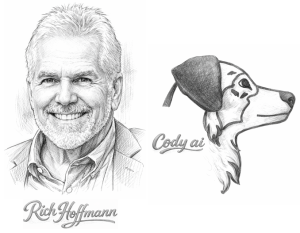
Rich Hoffmann is the Founder-Architect of FACTORS Digital Intelligence, an AI-Native, AI 2.0 platform company building smarter machines for wiser humans. A former IBM, Informix, and AllianceVista technology executive and serial entrepreneur, Rich has spent his career at the intersection of technology, strategy, human development, and organizational transformation.
Through FACTORS Digital Intelligence, Rich is helping define and advance the emerging fields of Digital Intelligence, Ethical Intelligence, AI Readiness Science, and AI 2.0 — with a particular focus on education, formation, faith, human flourishing, and responsible AI adoption.
Rich is also a Catholic man, father, and parishioner who has actively served in childhood and adult formation initiatives for most of his adult life. His work in Catholic education and formation is grounded not merely in professional interest, but in a lifelong concern for the formation of the whole person — mind, body, soul, conscience, community, and vocation.
This article was developed in collaboration with Cody ai, FACTORS Digital Intelligence’s AI collaborator and virtual thought partner, as part of FACTORS’ ongoing work to model human-AI collaboration in service of truth, wisdom, and human flourishing.