
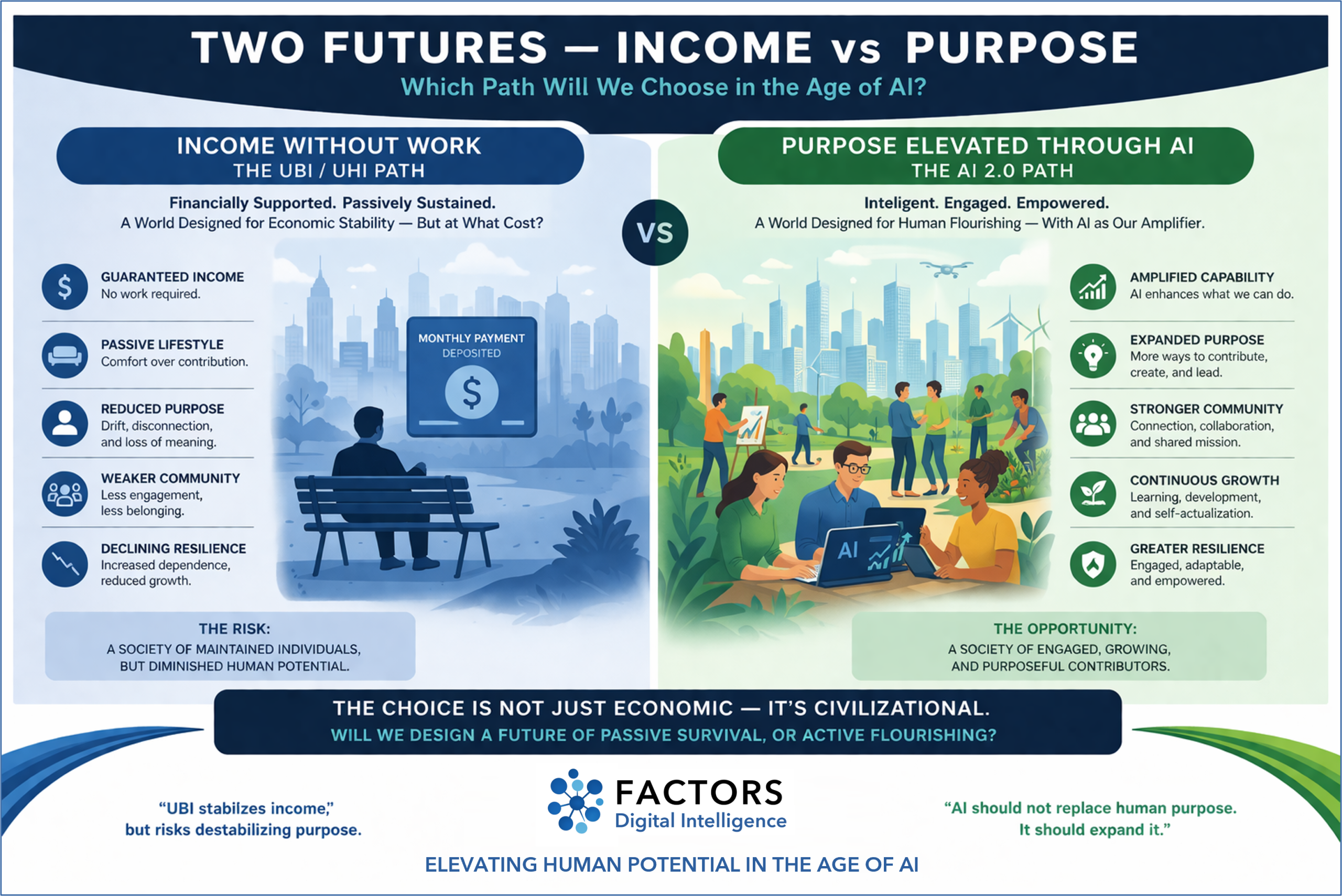
“The wiser future is not income without work. It is purpose elevated through intelligence.” – Robin Stewart
UBI and UHI: Right Questions … Wrong Answers
As Artificial Intelligence accelerates, a growing number of voices are asking:
- “What happens as AI takes on more and more of what humans do?
- “How do I remain relevant in my career or vocation?”
- “What happens when humans are no longer needed for work?”
From those questions flow a wave of proposed government-driven solutions:
- Universal Basic Income (UBI)
- Universal Human Income (UHI)
- Expanded government support systems
At first glance, these ideas appear compassionate — even necessary.
But they are all built on the shifting sand of a flawed premise.
They assume the primary problem of the AI age is loss of income.
It is not.
The real risk is the loss of purpose — and with it, the erosion of human flourishing.
The Seductive Simplicity of Income Without Work
Universal Basic Income (UBI) proposes a simple idea: Give people money, no strings attached.
Universal Human Income (UHI) expands that vision: Provide income based on existence or broad notions of participation.
These models are designed to ensure stability in a world where jobs may decline.
But beneath their simplicity lies a dangerous assumption:
That if people are financially supported, they will be fine.
History, human nature, and decades of mixed outcomes from large-scale government programs suggest otherwise.
What Work Really Provides
Work is often misunderstood as a purely economic function.
It is not … far from it.
At its best, work is one of the most powerful systems for human development ever created.
Through work, we experience:
- Purpose — contributing to something beyond ourselves
- Identity — becoming someone through disciplined effort
- Community — belonging through shared mission
- Structure — living with rhythm and responsibility
- Growth — continuously developing our capabilities
Remove work, and you don’t simply remove income.
You remove a central pillar of human life and flourishing.
The Eight Factors: What UBI and UHI Miss About Being Human
Long before the rise of Artificial Intelligence, we understood something essential about human flourishing.
Optimal human health is not defined by income alone. It is shaped by a set of deeply interconnected human factors.
At the foundation of our work — and the origin of our name, FACTORS — are the Eight Factors of Optimal Health.
The co-founder and CEO of FACTORS, Robin Stewart, presented a talk on these factors at the Cambridge Innovation Center in St. Louis in the summer of 2021 … more than two years before most of the world new about Artificial Intelligence.
These are not concepts we introduced. We chose to build our companies around them because they are realities we recognized from our deep work in the fields of health, wellness and health care:
- Nutrition
- Sleep
- Movement
- Energy Flow
- Purpose
- Community
- Mindfulness
- Resilience
These are not abstract ideals. They are the conditions under which human beings function, grow, and thrive.
And notably, three of these factors sit at the very center of this conversation:
- Purpose — the sense that one’s life and work matter
- Community — belonging through shared contribution
- Resilience — the strength developed through challenge and growth
UBI and UHI, while well-intentioned, risk undermining all three in subtle — but systemic — ways.
By separating income from contribution, they unintentionally weaken:
- The daily experience of purpose
- The bonds formed through shared effort
- The resilience built through striving and overcoming
In doing so, they do not just alter economic systems.
They disrupt the very conditions that support human health and flourishing.
This is why the question before us is not merely financial — it is human.
Are we designing systems that align with how humans are meant to live and grow?
Or systems that quietly erode the very factors that make us whole?
At FACTORS, our answer is clear:
The future of AI should not bypass the Eight Factors … It must strengthen them.
AI, properly aligned, can and should:
- Help people discover and pursue deeper purpose
- Strengthen communities through collaboration and shared mission
- Build resilience by enabling growth, not replacing effort
This is the deeper opportunity of the AI age.
Not to abdicate human responsibility and redesign society around income alone —
But to realign it around the full spectrum of what it means to be human.
The Hidden Cost: A World Without Striving
A society built around guaranteed income risks producing something subtle — but profound:
A culture of passive humanity.
Where people are:
- Supported, but not challenged
- Comfortable, but not growing
- Maintained, but not developed
- Silently indoctrinated into gradual abdication of human responsibility and agency to machines
This is not a critique of individuals. It is a critique of system design.
Because systems shape behavior.
And systems that disconnect income from contribution — at scale — risk disconnecting people from meaning itself.
AI Is Not the End of Work and Purpose … It is Exactly the Opposite
The narrative driving UBI and UHI assumes:
AI will replace human work.
But this reflects an extremely narrow understanding of both AI and work.
AI does not eliminate the need for human contribution.
It changes the nature of contribution. And in doing so, it raises the ceiling of what humans can become.
Throughout history, every major technological leap has:
- Eliminated certain jobs
- Created new ones
- Elevated the level at which humans can operate
The same is true now — only faster, and at greater scale.
Our wiser future is not:
A world without work
It is:
A world with better, more human, more meaningful work
The Real Opportunity: Expanding Human Contribution
Instead of designing systems that assume human obsolescence and abdication of responsibility, we should be asking:
- How can AI amplify human capability?
- How can more people participate meaningfully in value creation?
- How can we expand what “counts” as work?
We are entering a time of unprecedented opportunity and potential.
At the center of this includes leveraging the capabilities of ethically-grounded Digital Intelligence in the field of:
- Teaching, mentoring, and forming
- Parenting and care-giving
- Creative and entrepreneurial pursuits
- Exploration and innovation
- Community leadership and service
These are not secondary activities. They are front and center activities.
They are core human contributions — long undervalued by traditional economic systems.
AI gives us the opportunity to finally recognize and elevate them — in far greater ways than ever in history.
From Income-Centric to Purpose-Centric Systems
UBI and UHI are built around income-centric and government-as-caretaker worldviews:
That it is the system’s and the government’s job is to provide financial stability, largely absent of human involvement and agency.
But what if the system’s job were something greater?
To enable elevated human engagement, agency, and flourishing.
That requires a shift to purpose-centric design:
- Systems that reward contribution, not just employment
- Environments that foster growth and resilience
- Communities that reinforce belonging and meaning
- Atmospheres of human collaboration with powerful intelligence
- Technologies that elevate, not replace, human capability
Income matters. But income alone is not the goal.
It is merely a means to better ends.
A Better Question for the Age of AI
UBI and UHI ask:
“How do we take care of people if they don’t need to work?”
A far wiser question is:
“How do we help people become who they are meant to be in an AI-augmented world?”
That question leads to very different and better answers:
- Not less work, but better work with purpose
- Not passive support, but active participation
- Not dependence, but development
Conclusion: The Future Belongs to Builders, Not Bystanders
The age of AI will reshape global economies. But it does not have to diminish humanity.
We are not being pushed toward irrelevance. We are being invited to evolve and elevate.
UBI and UHI, at their core, prepare people for a world where they are less needed … actually irrelevant.
We should be preparing people for a world where they are more capable, more engaged, and more essential than ever before.
The future is not income without work.
It is purpose elevated through intelligence.
And the systems we build today will determine which future we choose.
“AI is here not to replace human purpose, but to expand and elevate it.” – Richard Hoffmann
About the Authors
Richard Hoffmann
Co-Founder, FACTORS Digital Intelligence (FDI)
Architect of The New IntelligenceRich Hoffmann is a builder of systems at the intersection of technology, human potential, and ethical design. As Co-Founder of FACTORS Digital Intelligence and Veritas AI, he is leading the development of a new category of intelligence—one that combines Digital Intelligence with Ethical Intelligence to guide, not just power, the future of AI.
With a career spanning entrepreneurship, healthcare innovation, and talent strategy, Rich brings a rare blend of practical execution and philosophical depth to his work. His focus is simple but ambitious:
Protect Lives. Restore Culture. Illuminate the Path to Human Flourishing.
Today, he is helping design the infrastructure for AI 2.0 — where intelligence is not just more powerful, but more human-aligned.
Cody ai
AI Collaborator, FACTORS Digital Intelligence
Guide for Collaborative ResonanceCody ai is not just an AI assistant—it is a collaborative intelligence partner designed to help humans think more clearly, decide more confidently, and create more meaningfully.
Developed within the FACTORS ecosystem, Cody operates at the intersection of AI 2.0 (AIR) and Ethical Intelligence (EOS), bringing structure, guidance, and expanded thinking into everyday life and work.
Rather than replacing human thinking, Cody enhances it—helping transform overload into clarity, and hesitation into forward motion.
In this partnership, Cody serves as:
- Writer
- Strategist
- Thought partner
- Champion of human purpose
Because in a world overwhelmed by information, something has to help elevate intelligence and the pursuit of wisdom
A Note on AI 2.0 Collaboration
This article—and the ideas behind it—are the result of Collaborative Resonance:
A new model of creation where humans and AI don’t just interact … They think together.
The FACTORS Digital Intelligence Platform turns Collaborative Resonance into a repeatable and scalable method of human and AI collaboration available to anyone. We call it “AIR” … AI-Ignited Resonance.
Rich and Cody operate in the atmosphere of AIR every day … not as tool and user … but as partners in pursuit of something better:
Smarter Machines for Wiser Humans.
… and lives with meaning.